
 en
en
 English
 русский
 Français
 Español
 Português
 Tiếng Việt
Content
- 1 Product Overview
- 2 Main Product Advantages
- 3 Applications of the 8cm Woven Elastic Panel
- 4 Comparison with Common Elastic Alternatives
- 5 Manufacturing Process and Production Strengths
- 6 Quality Management and Certifications
- 7 Customization Capabilities
- 8 Production Capacity and Delivery Support
- 9 How to Select and Use the Panel
- 10 Sustainability and Responsible Manufacturing
- 11 Why Choose a Professional Webbing Manufacturer?
- 12 Recommended Buyer Evaluation Checklist
- 13 Q&A
- 13.1 What is the width of the featured elastic panel?
- 13.2 What makes this product different from a narrow elastic band?
- 13.3 Is the panel suitable for waistbands?
- 13.4 Can it be used in activewear?
- 13.5 Can it be used in orthopedic braces or abdominal binders?
- 13.6 Does the panel resist curling?
- 13.7 Does the panel retain its shape after stretching?
- 13.8 What color is available for this product?
- 13.9 Can the elasticity be customized?
- 13.10 Does the company accept OEM and ODM orders?
- 13.11 What quality certifications does the company have?
- 13.12 How should the panel be tested before mass production?
- 13.13 Is this elastic panel itself a medical device?
- 13.14 Where is the manufacturer located?
- 13.15 How can buyers request more information?
- 14 Conclusion
- 15 References
- 16 Product: 8cm Dark Grey Woven Elastic Panels
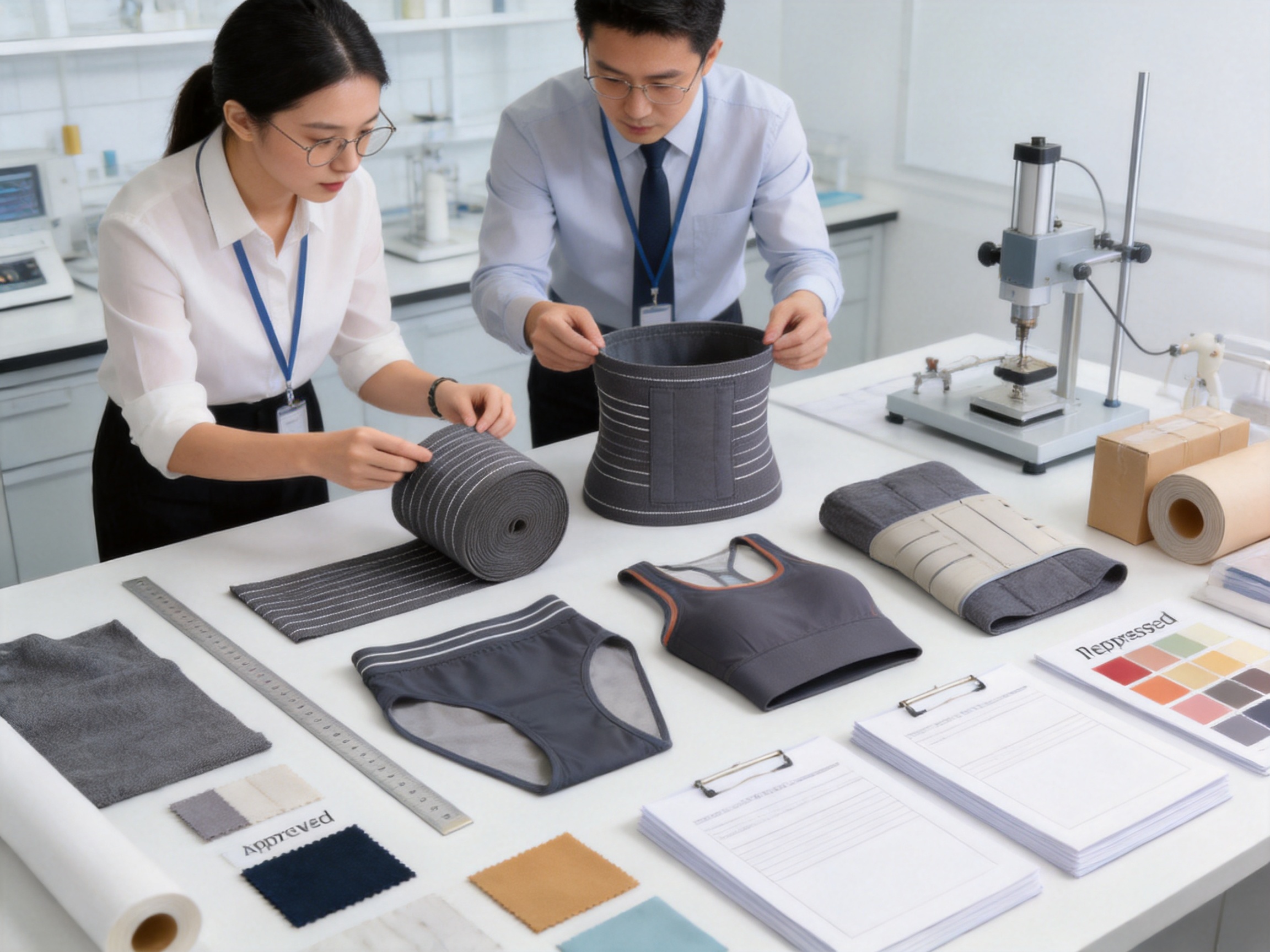
Elastic panels are important functional components in garments and support products where controlled stretch, reliable recovery, and comfortable contact with the body are required. Unlike decorative trims that are selected mainly for appearance, a functional elastic panel must maintain performance through repeated extension, compression, movement, washing, and daily wear. The 8cm dark grey woven elastic panel is designed for applications that require a broad, stable, and durable elastic surface. Its woven structure, wide format, firm support, modern dark grey color, and resistance to curling make it a practical choice for waistbands, activewear, orthopedic supports, sports protection products, and other garment applications.
The panel combines the structural advantages of woven elastic with the coverage provided by an 8cm width. This combination helps distribute tension over a larger area instead of concentrating pressure along a narrow edge. As a result, designers and manufacturers can use the panel to create garments and support products that require a balanced relationship between flexibility and stability. The panel is suitable for products that need to move with the wearer while retaining their original shape and position.
Manufactured by a professional webbing producer with more than 20 years of production experience, this elastic panel reflects a manufacturing approach centered on material control, equipment capability, process management, testing, packaging, and customer-specific customization. The production system includes warping machines, knitting machines, woven machines, and packaging machines, enabling the company to manage multiple stages of webbing production internally. This integrated capability supports consistency, efficient delivery, and the development of elastic products with tailored elasticity, texture, and color.
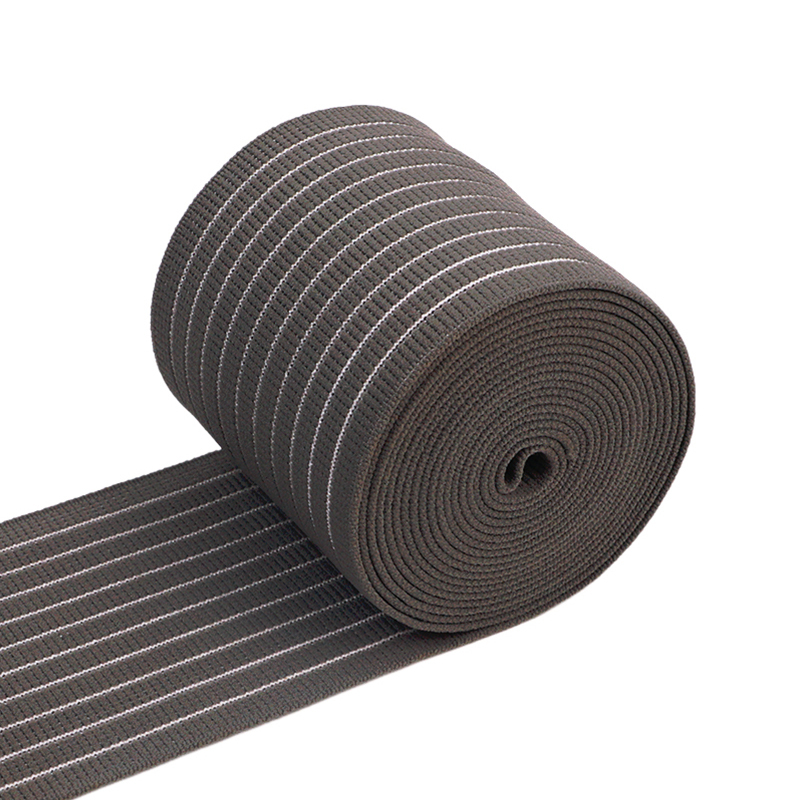
8cm Dark Grey Woven Elastic Panels
Product Overview
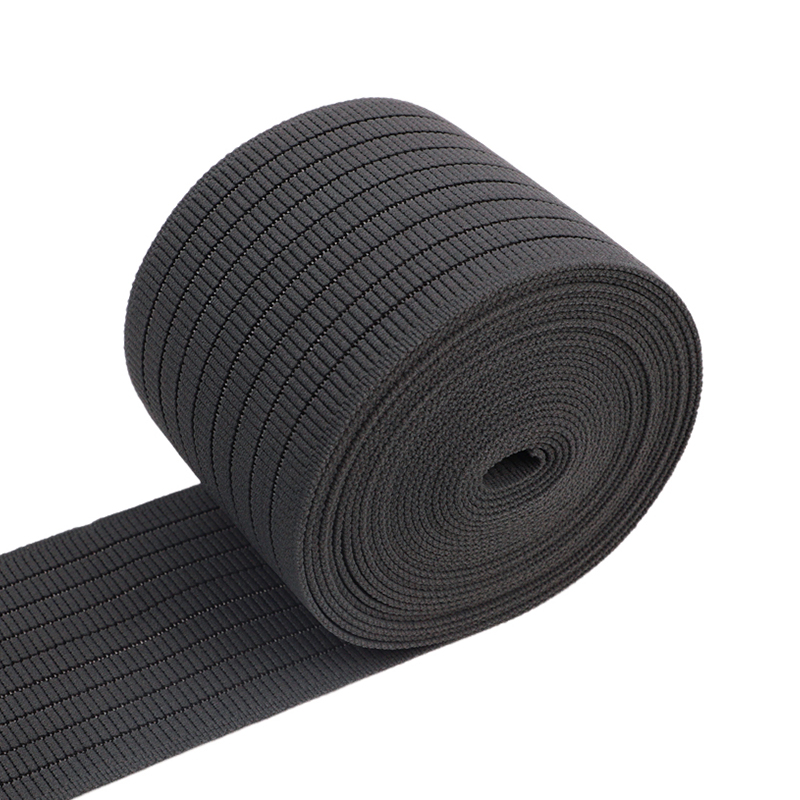
The 8cm dark grey woven elastic panel is a wide elastic textile component made with a durable woven structure. It is engineered to provide firm support, stable elasticity, and effective shape retention. The 8cm width offers a broad working surface, which is especially useful when a garment or support design requires even tension across the body or around a larger panel area.
The dark grey color gives the product a contemporary and understated appearance. It can be used in visible garment sections where a neutral technical color is preferred, or it can be incorporated into concealed structures where color coordination remains important during production. Dark grey is compatible with many black, charcoal, navy, grey, and sport-oriented color schemes, giving product designers additional flexibility when developing finished products.
Woven construction is one of the most important characteristics of this product. In a woven elastic panel, the textile structure is created through the organized interlacing of yarn systems. This structure helps the panel maintain width, resist deformation, and provide a stable base for controlled elasticity. Compared with a narrow elastic band, a woven panel can distribute force across a larger surface. Compared with a less structured stretch material, it can provide greater dimensional stability in applications where the product must remain aligned during movement.
The panel is intended for use in finished products rather than as a stand-alone medical treatment device. Its performance should be evaluated together with the fabric, stitching method, closure system, pattern design, and intended end use of the finished garment. For sports protection or orthopedic applications, manufacturers should conduct their own product validation and confirm that the final product meets all applicable technical and regulatory requirements.
Main Product Advantages
Wide 8cm Coverage
The 8cm width is a central advantage of this woven elastic panel. A wider panel can cover more surface area than a narrow elastic band, allowing tension to be spread more evenly. This is useful in waistbands, abdominal support sections, stabilizing straps, and garment areas where localized pressure may be uncomfortable or ineffective.
Wide elastic also creates more design possibilities. A manufacturer can use it as a complete support section, combine it with fabric panels, or cut and sew it into a layered construction. The broad surface can help simplify certain designs because fewer parallel narrow bands may be needed to achieve a similar visual or functional coverage. This can support a cleaner appearance and more consistent production layout.
In a waistband, the wide panel can help create a secure fit while reducing the tendency of the edge to dig into the body. In activewear, it can provide stable containment around the waist or other garment zones that require controlled movement. In support products, it can serve as a substantial elastic section that works with additional straps, hook and loop closures, or shaped textile components.
Firm and Stable Elasticity
The panel is designed to provide firm support while retaining the flexible properties expected from elastic webbing. Firm elasticity is valuable when a product must hold a garment section in position, maintain contact with the body, or resist unwanted movement during physical activity.
Stable elasticity means that the panel is intended to perform consistently during repeated extension and relaxation. A product that stretches easily but does not recover adequately can become loose, uneven, or ineffective. By contrast, a properly manufactured woven elastic panel can provide a more controlled response, supporting both comfort and functional reliability.
Stable elasticity is also valuable during sewing and assembly. When elastic components change unpredictably in length or tension, operators may experience uneven seams, puckering, inconsistent measurements, or variations between finished pieces. A stable panel can help manufacturers maintain more predictable production settings, although the correct sewing tension and equipment must still be selected for the specific design.
Resistance to Curling
Elastic edges that curl during use or assembly can create several problems. Curling can reduce the usable width, affect the appearance of the finished product, complicate stitching, and create uncomfortable contact with the wearer. The 8cm woven elastic panel is designed to resist curling, helping it remain flatter and more stable during use.
Resistance to curling is particularly useful in wide waistbands and support sections. A flat panel can maintain a more consistent contact area and help distribute tension across its full width. It can also make cutting, positioning, and sewing more manageable in production environments. The actual behavior of the panel will depend on the finished construction, edge treatment, seam design, and laundering conditions, but the woven format provides an appropriate foundation for dimensional control.
Shape Retention
Shape retention is a major consideration for elastic products used repeatedly. A garment or support product should ideally return toward its intended dimensions after stretching rather than remaining permanently distorted. The woven elastic panel is developed to offer excellent shape retention, helping finished products preserve their visual and functional form over time.
For manufacturers, shape retention can contribute to a longer useful life and a more consistent customer experience. A waistband that remains stable is more likely to retain its original fit. A sports support panel that maintains its shape can continue to provide predictable coverage. A garment component that resists deformation can also improve the perceived quality of the entire product.
Shape retention should be assessed under realistic conditions. Evaluation may include repeated stretch cycles, exposure to moisture, washing, drying, body heat, and contact with other materials. Since the final performance is affected by the entire garment system, the elastic panel should be tested after sewing into representative samples rather than only as an isolated component.
Durable Woven Structure
The durable woven structure provides a balance of flexibility and stability. The interlaced construction helps the panel withstand the mechanical demands associated with stretching, handling, sewing, and repeated use. It also provides a technical appearance that is suitable for sportswear, support products, and modern performance garments.
Durability is not limited to resistance against breakage. It also includes the ability to maintain width, recover after stretching, preserve a consistent surface, and remain functional through normal handling. A durable panel can reduce the risk of premature deformation and support the production of garments intended for active or repeated use.
Modern Dark Grey Appearance
Color is a functional and commercial consideration in garment manufacturing. Dark grey offers a restrained, professional appearance that can be used in performance products, support garments, waistbands, and technical apparel. It is less visually severe than pure black while remaining sufficiently neutral for many product designs.
The color can support coordinated product lines in which dark neutral tones are used to communicate strength, stability, and practicality. It may also be appropriate for products designed to combine textile performance with a modern appearance. When color matching is important, buyers should request a sample and confirm the final shade under their own lighting and production conditions.
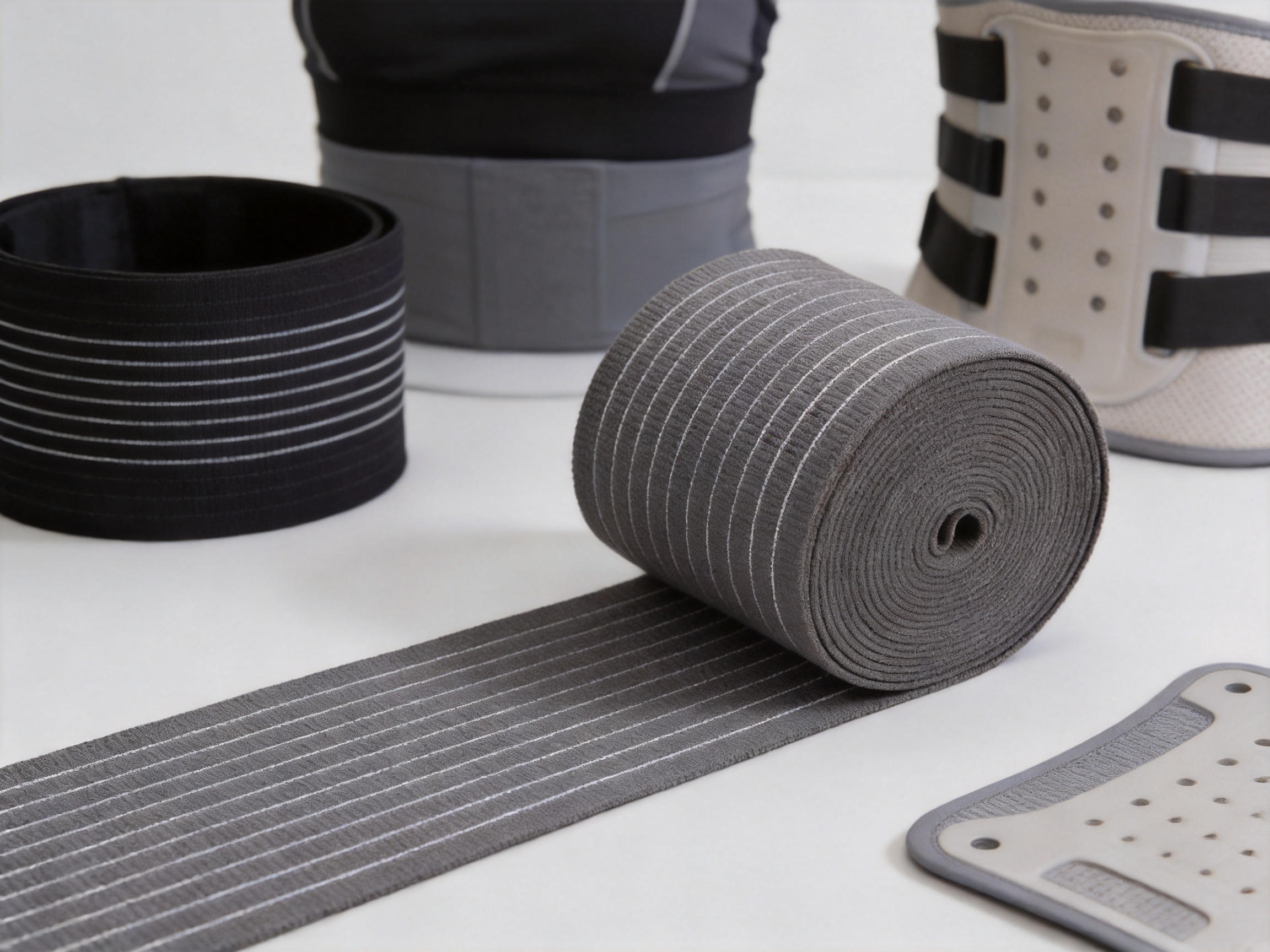
Applications of the 8cm Woven Elastic Panel
Waistbands
Waistbands are one of the most direct applications for a wide woven elastic panel. An 8cm panel can create a broad, supportive waistband in casual garments, activewear, workwear, shaping products, and selected support garments. The wide format helps the waistband remain visually substantial and can reduce the need to combine several narrow elastic strips.
In waistband construction, designers should consider the finished circumference, target extension, seam allowance, stitch type, and contact comfort. The panel can be sewn directly to fabric, enclosed within a casing, or incorporated into a layered waistband. Each method produces a different result. Direct attachment may provide a more integrated technical appearance, while an enclosed construction may create a softer surface against the body.
A wide waistband should be evaluated for both support and comfort. Excessive tension may cause discomfort, while insufficient tension may lead to slipping. The correct balance depends on the garment size range, fabric stretch, pattern shape, and intended activity level. Sampling and wear testing are therefore essential before mass production.
Activewear
Activewear requires materials that can respond to movement while maintaining a secure fit. The woven elastic panel can be used in sports shorts, training garments, performance tops, compression-inspired apparel, fitness clothing, and other active products. Its stable elasticity can help keep garment sections positioned during bending, stretching, walking, or exercise.
The panel can also contribute to the visual identity of activewear. Dark grey woven surfaces often complement technical fabrics and can be used as a contrasting or coordinating element. Designers may place the panel at the waist, under the bust, around a support zone, or along a structural seam, depending on the garment concept.
Because activewear is often exposed to perspiration, frequent washing, and repeated stretching, finished product testing is important. Manufacturers should evaluate the panel together with the selected fabric, thread, labels, coatings, and care process. The panel’s suitability should be confirmed under the exact conditions expected by the end user.
Sports Protection Products
Sports protection products frequently require elastic components that provide controlled tension and help keep protective sections in place. The 8cm panel can be incorporated into support sleeves, braces, stabilizing garments, protective belts, and other sports-related textile products. It may function as a primary elastic section or as part of a larger system that includes foam, fabric, stitching, molded parts, or hook and loop closures.
The wide construction can help distribute tension across a broader area, which may support a more stable fit than a narrow band alone. It can also provide a substantial base for stitching to adjacent materials. However, the performance of a sports protection product depends on the complete design. The panel itself should not be considered a substitute for product-specific testing, professional evaluation, or compliance assessment.
Orthopedic Braces and Support Garments
Elastic webbing is commonly used in orthopedic braces and support garments because it can provide adjustable tension and conform to body movement. The 8cm woven panel may be used in abdominal supports, lumbar support products, joint support garments, posture-related products, or other textile-based orthopedic constructions.
In these applications, the panel can work with hook and loop straps, fabric laminates, shaped inserts, and other webbing components. Its wide surface can help create a stable support zone, while its elasticity allows the product to accommodate different body positions. The panel may also be used as a reinforcement section in products where a narrow strap would not provide sufficient coverage.
For medical or orthopedic products, manufacturers must confirm the suitability of every material and the compliance status of the final device. A supplier’s quality systems and certifications support responsible manufacturing, but the finished product manufacturer remains responsible for product validation, labeling, risk management, and applicable market requirements.
Abdominal Binders
Abdominal binders require broad elastic sections that can provide adjustable support around the torso. An 8cm woven panel may be used as one part of an abdominal binder design, especially when combined with wider fabric sections or multiple fastening components. The panel’s stable elasticity and resistance to curling can help maintain a controlled shape during wear.
When designing abdominal binders, manufacturers should consider skin contact, pressure distribution, breathability, closure adjustment, edge finishing, and size grading. The elastic panel should be positioned so that it works with the complete binder rather than creating isolated pressure points. Prototype testing on representative body sizes can help identify issues related to tension, comfort, and movement.
General Garment Construction
The product may also be used in underwear, uniforms, protective clothing, workwear, loungewear, and other garments requiring a wide elastic element. It can function as a support strip, stabilizing component, waistband section, internal reinforcement, or visible design detail.
Its dark grey shade and broad format allow it to support both practical and aesthetic objectives. For products where elastic is visible, the panel can contribute to a technical design language. For concealed applications, it can provide the required functionality without demanding a complicated external appearance.
Comparison with Common Elastic Alternatives
Different elastic products are suited to different applications. Narrow elastic bands are useful when a small, discreet stretch element is required, but they may not provide the same coverage or force distribution as an 8cm panel. Knitted elastic can offer a soft hand and flexible behavior, but a woven panel may be preferred where greater structural stability and resistance to curling are priorities.
An elastic hook and loop strap provides adjustability and fastening functionality, but it is normally used as a closure component rather than as a continuous broad elastic panel. Medical elastic bandage may be selected for wrapping or compression-related uses, while a woven elastic panel is more directly suited to integration into sewn garments and structured support products.
| Product Type | Typical Strength | Potential Limitation Compared with a Wide Woven Panel | Best-Fit Consideration |
|---|---|---|---|
| 8cm woven elastic panel | Broad coverage, stable elasticity, shape retention, resistance to curling | Requires appropriate sewing and finished-product testing | Waistbands, activewear, support garments, sports protection |
| Narrow elastic band | Compact size and easy placement in small garment channels | Less coverage and potentially more concentrated tension | Underwear edges, small openings, lightweight garment details |
| Wide knitted elastic | Flexible hand and comfortable stretch in selected applications | May provide less structural stability in some designs | Soft waistbands and garments emphasizing flexibility |
| Elastic hook and loop strap | Adjustability and reusable fastening | Not primarily designed as a continuous support panel | Braces, closures, adjustable support products |
| Medical elastic bandage | Wrapping and compression-related flexibility | Different construction and application requirements | Bandaging and specialized clinical product designs |
The principal advantage of the 8cm woven elastic panel is its combination of width and structural stability. It is not intended to replace every other form of elastic. Instead, it serves applications where a broad, firm, durable, and relatively flat elastic section is more appropriate than a narrow band or a softer knitted construction.
Compared with ordinary elastic materials that may curl or lose their shape during repeated use, this woven panel is designed to remain stable and retain its intended form. Compared with a collection of narrow strips, it can offer a cleaner integrated appearance and potentially simplify the construction of broad support zones. These advantages should be confirmed through product-specific trials, especially when the panel is used in demanding or regulated applications.
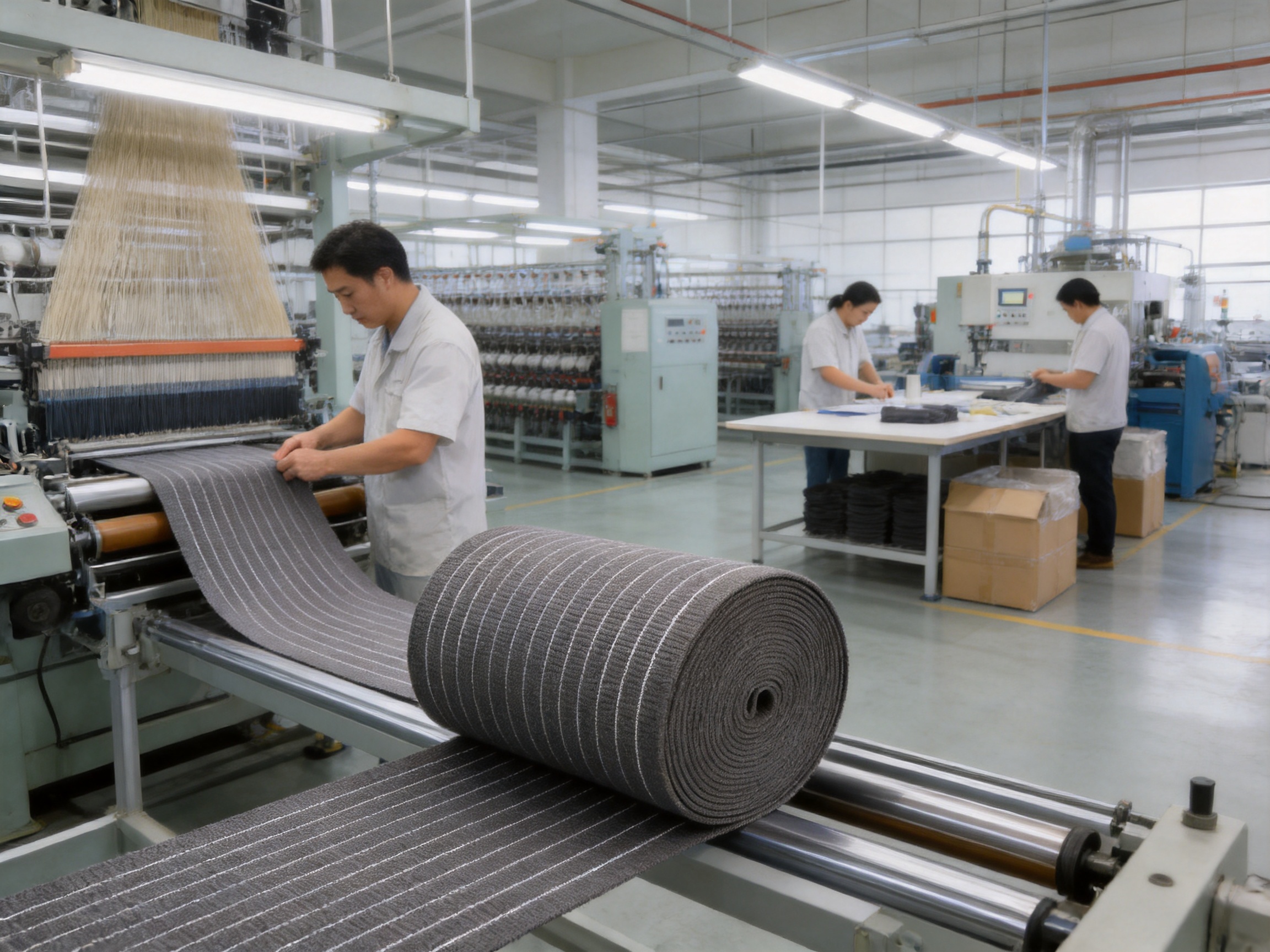
Manufacturing Process and Production Strengths
Material Sourcing and Preparation
Reliable elastic webbing begins with controlled raw material sourcing. Material selection affects stretch, recovery, surface appearance, tensile behavior, color, and long-term durability. The manufacturer maintains quality control throughout material sourcing and processing, supporting more consistent production from the beginning of the manufacturing cycle.
Before weaving, yarns and other required materials must be prepared according to the product specification. Preparation can include organizing yarns, confirming quantities, checking visual quality, and arranging the structure required for the target width and elasticity. Careful preparation helps reduce variations that could later appear as uneven edges, inconsistent density, or differences in stretch behavior.
Warping Operations
Warping is an important step in the production of woven webbing. It involves preparing yarns in an organized arrangement so that they can be fed consistently into the weaving process. Proper warping contributes to uniform width, balanced construction, and stable production conditions.
The company has introduced advanced warping machines as part of its equipment development. Modern warping equipment can support more orderly yarn preparation and improve production efficiency. It also helps the manufacturer respond to different specifications, including changes in width, structure, color, and performance requirements.
For an 8cm panel, accurate preparation is particularly important because the product has a broad surface that makes irregularities more visible. Controlled warping helps support a consistent woven appearance across the full width of the panel.
Woven Production
The panel is produced using woven machinery designed for elastic and non-elastic webbing. During weaving, the yarn systems are interlaced to create the panel’s durable structure. The machine settings and production parameters must be managed carefully to achieve the required width, texture, elasticity, and edge stability.
Woven production requires a balance between structural density and stretch performance. If the construction is too rigid, the panel may not provide the desired flexibility. If it is too loose or unstable, it may not maintain its shape adequately. The manufacturing objective is to produce a panel that provides firm support while remaining suitable for repeated extension and recovery.
Equipment capability is especially valuable when supplying customized webbing. Different customers may require variations in color, texture, width, elasticity, or surface feel. A manufacturer with experience in woven production can adjust its process within appropriate technical limits to address these requirements.
Process Monitoring
Quality control continues throughout processing rather than being limited to a final inspection. Operators and quality personnel can monitor the panel’s appearance, width, edge condition, texture, and general consistency during production. Continuous observation helps identify deviations earlier, reducing the risk that large quantities will be produced outside the required specification.
For elastic products, process monitoring should also consider stretch and recovery behavior. A panel can appear visually acceptable while still showing performance variations that affect the finished product. Controlling both visible and functional characteristics supports a more complete approach to quality management.
Testing and Inspection
Testing helps confirm whether the produced webbing meets the intended requirements. Depending on the customer specification and application, testing may involve dimensions, appearance, stretch, recovery, tensile behavior, color, and resistance to repeated use. Finished product manufacturers may also perform additional tests based on their own standards and market requirements.
The company emphasizes strict quality control during material sourcing, processing, testing, and packing. This sequence helps create traceability across the production process and supports more reliable order fulfillment. It also gives customers a clearer basis for evaluating samples and approving specifications before bulk production.
Packaging Operations
Packaging is the final manufacturing stage before shipment, but it can influence product quality during storage and transportation. Proper packaging helps protect the webbing from contamination, excessive handling, moisture exposure, and unnecessary deformation. Packaging machines are included among the company’s updated production equipment, supporting more organized and efficient preparation for delivery.
Customers may require specific roll lengths, labels, carton arrangements, protective materials, or identification systems. These requirements should be agreed upon before production. Clear packaging information can help receiving departments identify products, manage inventory, and maintain lot control.
Quality Management and Certifications
The manufacturer has obtained Oeko-Tex Standard 100 and ISO 13485 certificates. These certifications are significant indicators of the company’s commitment to controlled production and quality management. Oeko-Tex Standard 100 is associated with testing textiles for harmful substances according to the applicable certification criteria. ISO 13485 is a quality management standard associated with organizations involved in medical devices and related products.
Certifications do not eliminate the need for customer testing or finished-product compliance review. Instead, they provide a structured foundation for manufacturing control. Buyers should confirm the scope, validity, and applicability of any certification to the specific product, production site, and intended use.
For sports protection, orthopedic braces, and medical protective equipment, quality management is especially important. These products can involve body contact, repeated tension, pressure distribution, and safety-related performance. A supplier that maintains documented processes and controlled production conditions can offer valuable support to customers developing such products.
Quality also includes communication. Accurate specifications, sample approvals, production schedules, packaging requirements, and inspection expectations should be documented between the buyer and supplier. Clear communication reduces misunderstandings and helps ensure that the delivered elastic panel matches the approved sample and purchase requirements.
Customization Capabilities
Different applications require different elastic characteristics. The manufacturer provides customized elastic and non-elastic webbing with tailored elasticity, texture, and color. This allows customers to develop products that are more closely aligned with their garment design, target users, and production methods.
Elasticity Customization
Elasticity can influence comfort, support, recovery, and fit. A sports garment may require a different level of tension from a casual waistband. An orthopedic brace may require a controlled stretch range that works with its closure system. By discussing the intended use, finished dimensions, extension requirements, and recovery expectations, customers can work toward a more appropriate specification.
Elasticity should be assessed under defined test conditions. Factors such as extension percentage, holding time, relaxation, repeated cycles, temperature, moisture, and test direction can affect results. A professional development process should record the test method so that samples and bulk production can be compared consistently.
Color Customization
Although the featured product is dark grey, customized colors may be available for different product programs. Color selection can support brand identity, garment coordination, contrast details, and customer preferences. Buyers should provide a recognized color reference where possible and approve a physical sample before bulk production.
Color evaluation should consider lighting, surrounding materials, dye lot variation, and finishing conditions. A digital image or screen display may not accurately represent the final textile shade. Physical approval is therefore recommended for products where visual matching is important.
Texture and Surface Requirements
The surface texture of elastic webbing influences hand feel, appearance, friction, and sewing behavior. Some products require a smooth surface for comfort, while others may prefer a more technical or structured texture. Customers can discuss the desired surface characteristics during development and evaluate them in relation to the final garment.
Texture should not be considered separately from elasticity and construction. Changes to density, yarn arrangement, or finishing may affect both the surface and the stretch behavior. A balanced specification is necessary to ensure that the customized product performs effectively in its intended application.
OEM and ODM Support
OEM and ODM orders are welcome. OEM cooperation allows customers to provide their own specifications, designs, or technical requirements for production. ODM cooperation can involve greater participation from the manufacturer in product development, material selection, structure, and specification refinement.
For efficient development, customers should provide as much information as possible, including intended application, finished width, color, desired elasticity, sample dimensions, sewing method, expected order quantity, packaging requirements, and delivery schedule. The more complete the initial information, the more efficiently the supplier can recommend a suitable production route.
Production Capacity and Delivery Support
The company produces millions of meters of elastic and non-elastic webbing every month. This production capacity supports both standard products and larger supply programs, subject to confirmed specifications and production schedules. High capacity can be valuable for customers who require continuity between development orders, pilot production, and regular bulk purchasing.
Production scale should be supported by process discipline. Large output alone does not guarantee consistency. The combination of updated equipment, quality control, experienced personnel, testing, and packaging management helps create a more reliable manufacturing system. Customers should still confirm lead times, minimum order quantities, sample arrangements, and inspection procedures for each project.
Timely delivery is an important part of supply chain performance. A delay in elastic webbing can interrupt cutting, sewing, assembly, and shipment of the finished product. The manufacturer’s emphasis on efficient equipment, organized production, and customer service is intended to support competitive pricing and timely delivery.
Customers serving international markets may also benefit from the company’s export experience. Products are sold across China and exported to North America, Eastern Europe, the Middle East, South Asia, and other regions. Familiarity with international business communication and export coordination can support smoother cooperation, although all shipping, documentation, and import requirements should be confirmed for each order.
How to Select and Use the Panel
Define the Intended Application
The first step is to define how the panel will be used. A waistband, activewear garment, abdominal binder, orthopedic brace, and sports protection product may all require different performance targets. The application determines the appropriate stretch, tension, seam construction, contact conditions, and testing plan.
Confirm Finished Dimensions
The nominal width of the product is 8cm, but the finished design must also account for seam allowances, overlap, fabric integration, and any edge finishing. Buyers should confirm the dimensional tolerance required for their cutting and sewing process. If the panel will be inserted into a channel, the channel width and clearance should be tested with actual production samples.
Evaluate Tension and Recovery
Elastic tension should be evaluated at the extension range expected in the finished product. A panel may perform differently when lightly stretched, highly extended, held under tension, or repeatedly cycled. Measuring only one point may not provide enough information for a demanding application.
Recovery is equally important. After extension, the panel should be observed for immediate recovery and longer-term relaxation. The finished garment should also be assessed because stitching, fabric stretch, and seam placement can change the behavior of the elastic component.
Select Suitable Sewing Methods
Woven elastic panels can be integrated into garments using different sewing methods. The appropriate method depends on the fabric, desired appearance, required strength, and production equipment. Stitch density, thread type, needle selection, seam allowance, and presser-foot pressure may all affect the result.
Excessive sewing tension can restrict the elastic or create puckering. Insufficient reinforcement may lead to seam failure during extension. Manufacturers should develop a sewing sample and test the seam under realistic load conditions before approving bulk production.
Conduct Wear and Laundering Tests
Wear testing can reveal issues that are not visible in laboratory measurements. Test users or controlled trials can help evaluate comfort, slipping, pressure, curling, surface feel, and overall fit. Laundering tests can examine changes in dimensions, elasticity, color, texture, and seam condition.
The appropriate care cycle depends on the finished garment and target market. Washing temperature, detergent, agitation, drying method, and repeated cycles should reflect the product’s intended care instructions. The elastic panel should be tested as part of the assembled product whenever possible.
Sustainability and Responsible Manufacturing
Sustainability in textile production includes material efficiency, equipment efficiency, product durability, quality control, packaging management, and responsible customer communication. A durable elastic panel that maintains its performance for a longer period may help reduce premature replacement and material waste. Stable production can also reduce rejected rolls and manufacturing losses.
The company’s commitment to sustainability is connected with its broader focus on quality, innovation, and continuous improvement. Updated warping, weaving, knitting, and packaging equipment can support more efficient manufacturing, while process controls help reduce avoidable variation.
Customers seeking sustainability information should discuss the specific materials, production conditions, packaging, testing, and available documentation for each project. Sustainability claims should be based on verifiable product and process information rather than general assumptions. The Oeko-Tex Standard 100 certification may be relevant to textile safety considerations, but buyers should confirm the exact certified scope and current documentation.
Why Choose a Professional Webbing Manufacturer?
Choosing a professional webbing manufacturer can reduce the risks associated with inconsistent elasticity, unstable width, poor edge behavior, limited customization, and uncertain delivery. A specialized producer understands that elastic webbing is a technical textile component rather than a simple decorative accessory.
The manufacturer described here has operated since 2005 and focuses on elastic webbing and non-elastic webbing, particularly for sports supports and orthopedic braces. Its experience covers research and development, production, sales, service, testing, and packaging. This range of capability can help customers obtain more coordinated support throughout the product development and purchasing process.
The company’s equipment includes warping machines, knitting machines, woven machines, and packaging machines. This equipment base supports a broad product category that includes abdominal binder elastic, woven wide elastic, wide knitted elastic, narrow elastic band, woven elastic panels, elastic hook and loop straps, and medical elastic bandage.
Its location in Jinhu County, Huai’an City, Jiangsu Province, China, places the production operation within an established Chinese manufacturing environment. The company serves domestic and international customers, welcomes OEM and ODM orders, and aims to build long-term partnerships through integrity, responsibility, reliable quality, and continuous improvement.
For buyers, the most important benefit is not simply access to one elastic panel. It is the ability to work with a supplier that can discuss specifications, provide samples, adjust product characteristics, manage production, conduct quality control, and prepare orders for shipment. This type of cooperation can be especially useful when a product line includes several related webbing components.
Recommended Buyer Evaluation Checklist
| Evaluation Area | Questions to Confirm |
|---|---|
| Product specification | Is the required width 8cm, and what tolerances apply to width, thickness, and length? |
| Elastic performance | What extension range, support level, recovery behavior, and repeated-cycle performance are required? |
| Appearance | Has the dark grey shade, texture, and surface appearance been approved using a physical sample? |
| Application | Will the panel be used in a waistband, activewear garment, sports product, brace, binder, or another construction? |
| Sewing method | What machine, stitch type, thread, seam allowance, and reinforcement method will be used? |
| Testing | Which dimensional, tensile, recovery, laundering, color, and finished-product tests are required? |
| Certification | Which certificates and documents apply to the material, production site, and intended finished product? |
| Packaging | What roll length, labeling, carton, protective packaging, and identification requirements apply? |
| Supply planning | What are the sample lead time, production lead time, minimum order quantity, and delivery terms? |
Q&A
What is the width of the featured elastic panel?
The featured panel has a nominal width of 8cm. Buyers should confirm the applicable tolerance and finished dimensions with the supplier before production.
What makes this product different from a narrow elastic band?
The 8cm woven panel provides broader coverage and can distribute tension over a larger surface. It is designed for applications where a stable, substantial elastic section is preferred over a compact narrow band.
Is the panel suitable for waistbands?
Yes. Its wide format, firm support, stable elasticity, resistance to curling, and shape retention make it suitable for many waistband designs. The correct tension and sewing method should be established through sampling.
Can it be used in activewear?
Yes. The panel can be incorporated into activewear and performance garments that require a secure, stable elastic section. Finished garments should be tested for movement, comfort, washing, and repeated stretching.
Can it be used in orthopedic braces or abdominal binders?
It may be used as a component in orthopedic braces, abdominal binders, sports supports, and related products. The complete product must be evaluated for safety, comfort, pressure distribution, durability, and applicable regulatory requirements.
Does the panel resist curling?
The product is designed to resist curling during use. Actual edge behavior can also be influenced by sewing, lamination, fabric selection, washing, and the shape of the finished garment.
Does the panel retain its shape after stretching?
The panel is designed to offer excellent shape retention. Buyers should confirm performance through agreed test methods and assess the panel after it has been integrated into the intended finished product.
What color is available for this product?
The featured product is dark grey. Customized colors may also be available. A physical color sample should be approved before bulk production when exact color matching is important.
Can the elasticity be customized?
The manufacturer provides customized webbing with tailored elasticity, texture, and color. Customers should provide detailed application information and approve development samples before placing a bulk order.
Does the company accept OEM and ODM orders?
Yes. OEM and ODM orders are welcome. Cooperation may include production according to customer specifications or support with product development and specification refinement.
What quality certifications does the company have?
The company has obtained Oeko-Tex Standard 100 and ISO 13485 certificates. Buyers should confirm the current certificate details, scope, and applicability to their specific order.
How should the panel be tested before mass production?
Testing should include appearance, width, elasticity, recovery, seam performance, repeated stretching, laundering, and finished-product wear assessment as appropriate. The test plan should reflect the actual application and target market.
Is this elastic panel itself a medical device?
The panel is a textile component. Its use in a medical or orthopedic product does not automatically make the panel itself a medical device. The finished product manufacturer is responsible for determining classification, testing, risk management, labeling, and regulatory compliance.
Where is the manufacturer located?
The company is located in Gongnong Village, Licheng Town, Jinhu County, Huai’an City, Jiangsu Province, China.
How can buyers request more information?
Buyers can contact the manufacturer to discuss specifications, samples, customization, production capacity, packaging, certificates, and delivery planning. The listed contact details are phone 0086-15895705812 and email john@mixshowint.com.
Conclusion
The 8cm dark grey woven elastic panel is a practical solution for garments and support products that require broad coverage, firm support, stable elasticity, resistance to curling, and dependable shape retention. Its woven structure provides a balance of flexibility and dimensional stability, while the 8cm width helps distribute tension across a larger area. These characteristics give the panel advantages over narrower elastic bands in applications such as waistbands, activewear, abdominal binders, sports protection products, and selected orthopedic constructions.
The product’s value is strengthened by the manufacturer’s production capabilities. Since its establishment in 2005, the company has developed experience in elastic and non-elastic webbing, invested in warping, knitting, weaving, and packaging equipment, and maintained quality control from material sourcing through shipment. Its Oeko-Tex Standard 100 and ISO 13485 certifications provide additional evidence of a structured quality approach, subject to verification for the specific order and application.
Customization is another important strength. Customers can discuss elasticity, texture, color, width, packaging, and other technical requirements for OEM and ODM projects. The company’s monthly production of millions of meters and experience serving customers in China and overseas markets support both development projects and larger supply programs.
For the best result, buyers should define the intended use, approve samples, evaluate stretch and recovery, test sewing construction, confirm color, and conduct finished-product validation. When selected and integrated correctly, the 8cm dark grey woven elastic panel can provide a durable and professional foundation for modern garments, sports products, and textile-based support solutions.
References
1. Jinhu Hengxiang Webbing Co., Ltd. Product information for 8cm Dark Grey Woven Elastic Panels.
2. Jinhu Hengxiang Webbing Co., Ltd. Company information and manufacturing capability statement.
3. Oeko-Tex Association. Standard 100 textile safety and harmful-substance testing principles.
4. International Organization for Standardization. ISO 13485 quality management systems for medical devices.
5. General textile product development practices for elastic webbing specification, sewing evaluation, dimensional testing, and laundering assessment.