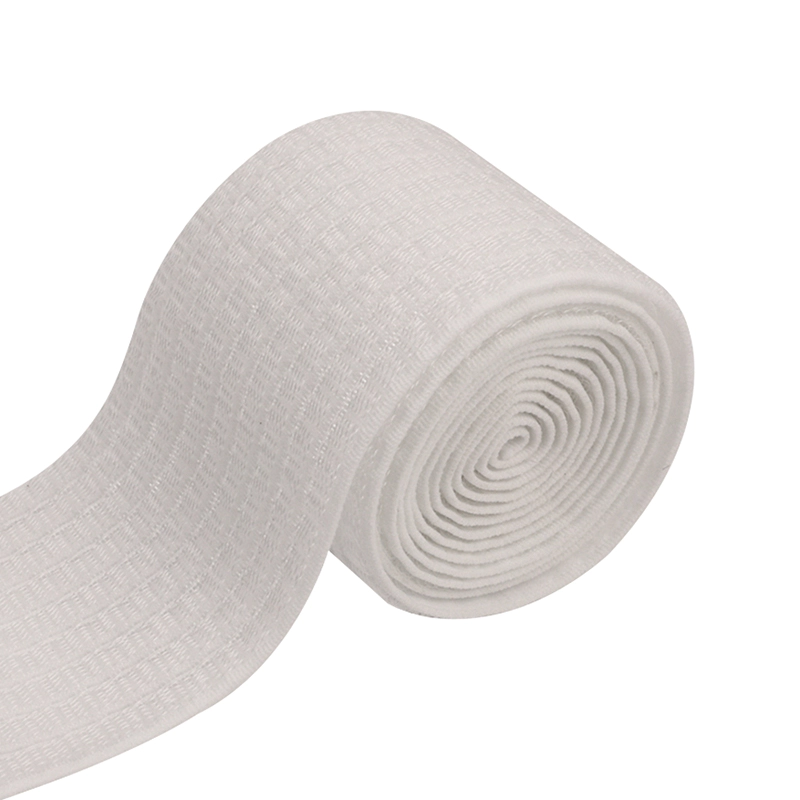

 en
en
 English
 русский
 Français
 Español
 Português
 Tiếng Việt
Content
- 1 Introduction
- 2 What Is 8cm Black Knitted Elastic?
- 3 Core Construction and Material Characteristics
- 4 Main Advantages Over Narrow or Lower-Quality Alternatives
- 5 Applications of 8cm Black Knitted Elastic
- 6 Manufacturing Strengths and Production Capabilities
- 7 Customization and OEM/ODM Services
- 8 How 8cm Black Knitted Elastic Compares with Other Elastic Types
- 9 Design and Processing Recommendations
- 10 Why Choose a Specialized Webbing Manufacturer?
- 11 Quality, Sustainability, and Long-Term Value
- 12 Purchasing Checklist for Buyers
- 13 Frequently Asked Questions
- 13.1 What is the width of this elastic?
- 13.2 What is the product model?
- 13.3 What makes knitted elastic different from woven elastic?
- 13.4 Is this elastic suitable for direct skin contact?
- 13.5 Can it be used for abdominal binders?
- 13.6 Can it be used in sports supports and orthopedic braces?
- 13.7 Is the black color durable?
- 13.8 Can the elastic be customized?
- 13.9 Is it easy to cut and sew?
- 13.10 What certificates does the manufacturer have?
- 13.11 What other products does the manufacturer supply?
- 13.12 Where is the manufacturer located?
- 13.13 How can customers request product information?
- 14 Conclusion
- 15 References
- 16 Product: 8cm Black Knitted Elastic
Introduction
Elastic webbing is a functional textile component used to provide controlled stretch, recovery, support, comfort, and secure fitting in a wide range of products. From clothing waistbands and shapewear to sports supports, orthopedic braces, medical accessories, and protective equipment, the right elastic material can significantly influence the performance and service life of the finished product.
The 8cm Black Knitted Elastic is a wide knitted elastic designed for applications that require dependable elasticity across a broad surface area. With an 8cm width, it can distribute tension more evenly than narrow elastic bands, helping reduce pressure concentration, rolling, pinching, and deformation. Its knitted construction also provides a balance of flexibility, softness, breathability, and structural stability.
Made from high-quality yarns, this elastic offers a soft touch and consistent stretch. The classic black color provides a clean, professional appearance and makes the material easy to coordinate with black, dark-colored, neutral, and performance-oriented fabrics. It is suitable for industrial manufacturing as well as smaller custom projects, including cutting and sewing applications.
This article explains the construction, advantages, applications, manufacturing considerations, quality expectations, and purchasing value of 8cm Black Knitted Elastic. It also introduces the production strengths and customization capabilities of Jinhu Hengxiang Webbing Co., Ltd., a professional manufacturer of elastic and non-elastic webbing for garment, sports protection, and medical protective applications.
What Is 8cm Black Knitted Elastic?
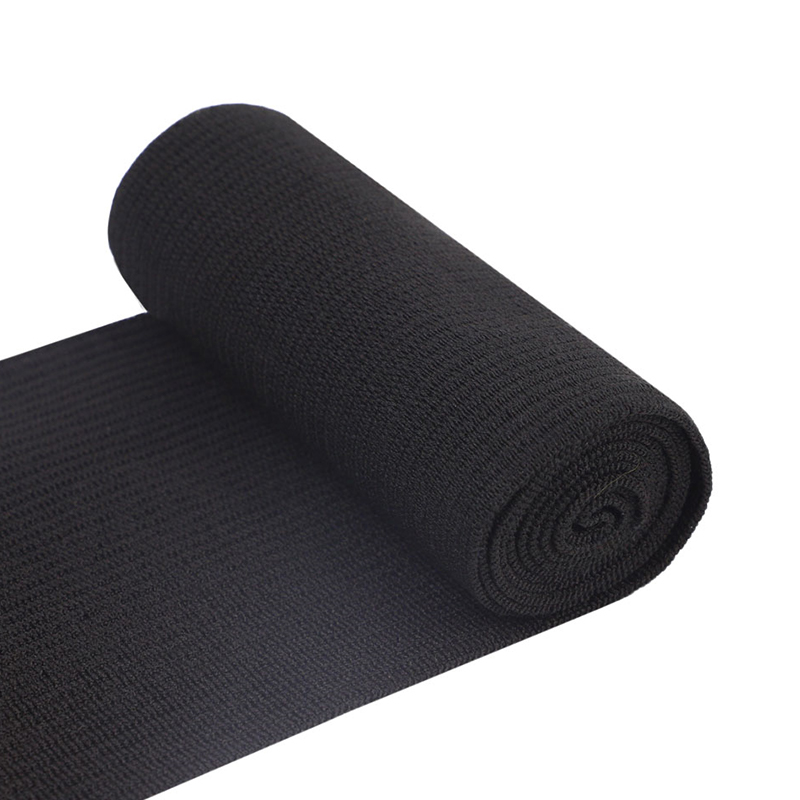
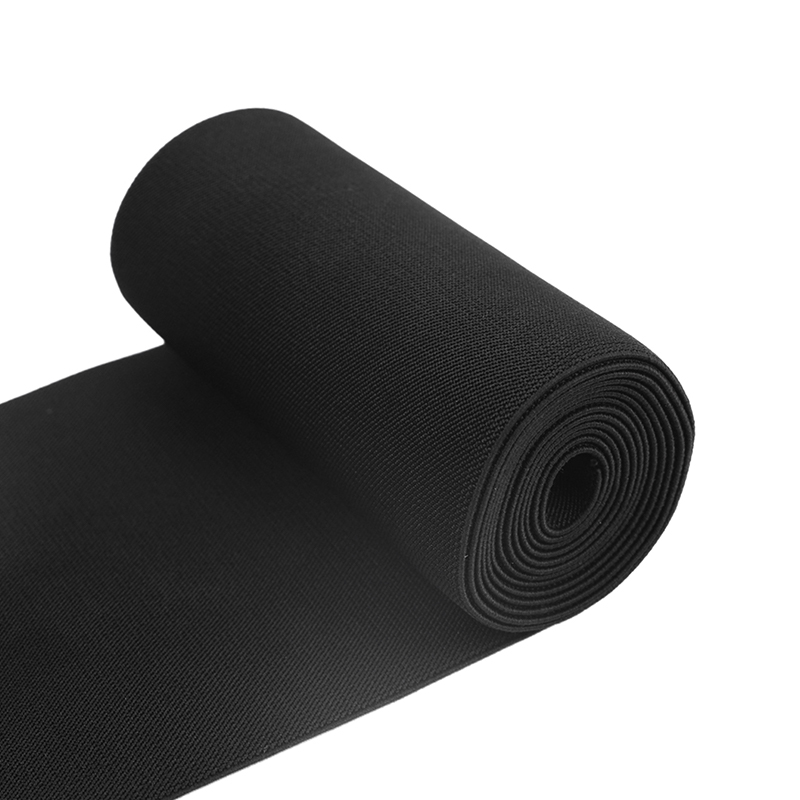
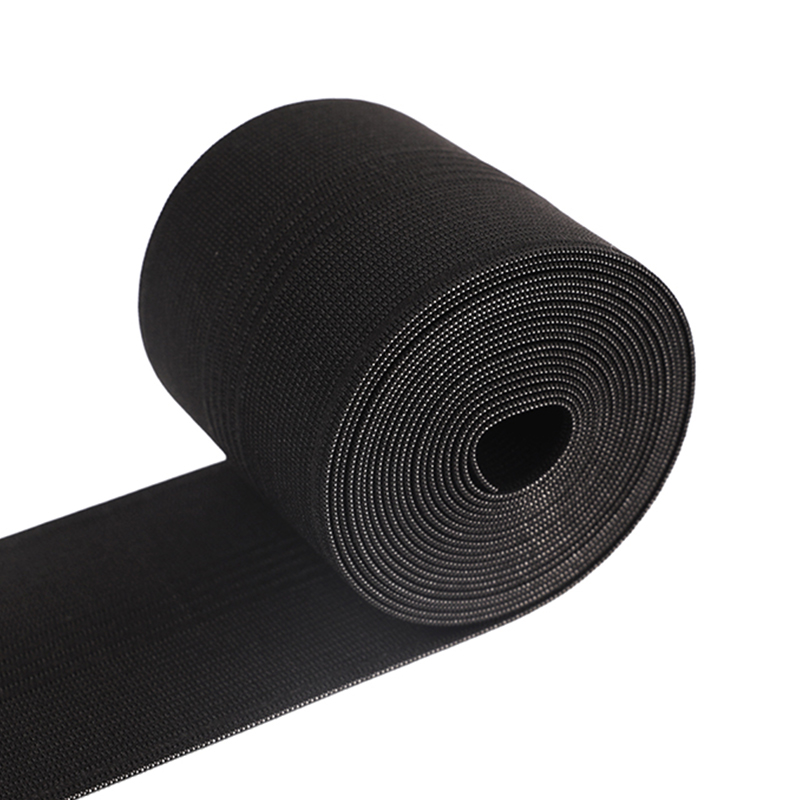
8cm Black Knitted Elastic is a wide elastic textile with a nominal width of 8cm. Unlike rigid woven tape, knitted elastic is formed through an interlooping textile structure. This construction allows the material to extend and recover while maintaining a soft, flexible surface.
The knitted structure is particularly useful when the elastic must follow body contours or move repeatedly with the wearer. Instead of acting as a stiff strip, the material can flex in response to movement. This makes it suitable for products that need both controlled support and a comfortable fit.
The product is identified as model 8050. Its principal features include premium yarns, wide-width construction, strong elasticity and recovery, a breathable knitted texture, durable black dyeing, and ease of cutting and sewing. These characteristics make it adaptable to a broad range of textile designs.
Width is an important performance factor in elastic webbing. A wider band can spread tension over a larger area, which is often preferable for waistbands, support garments, abdominal products, and other applications where a narrow strip may create uncomfortable pressure points. The 8cm format offers a practical balance between coverage and flexibility.
Because the material is black, it can be used as a visible design element or concealed inside a garment. It can coordinate with black outer fabrics, provide a discreet internal component, or create contrast against lighter textiles. The even color appearance also supports a neat and consistent finished product.
8cm Black Knitted Elastic
Core Construction and Material Characteristics
High-Quality Yarn Selection
The quality of an elastic textile begins with its raw materials. High-quality yarns can contribute to a softer hand feel, more uniform elasticity, better appearance, and improved resistance to repeated use. In a knitted structure, yarn quality also influences loop consistency and surface smoothness.
For manufacturers of garments and medical or sports products, the touch of the elastic is important because the material may remain in contact with the skin for extended periods. A rough or unstable elastic can cause discomfort, friction, or pressure. By contrast, a soft knitted surface can support a more pleasant user experience when properly incorporated into the finished product.
Material selection also affects processing performance. Consistent yarn characteristics help the knitting machine produce a more uniform structure. This can reduce variation between production runs and make the elastic easier to cut, sew, and integrate into different product designs.
Wide 8cm Format
The 8cm width is one of the product’s most important functional advantages. Narrow elastic bands concentrate their tension into a small area. In some applications, that concentration may lead to pinching, rolling, or uneven pressure. A wide band can distribute force over a broader section of fabric or the body.
This wider coverage is useful for abdominal binders, support garments, shapewear, waistbands, sports protection products, and orthopedic brace components. It can also help designers create a more stable fit without relying on excessive tightness.
Wide elastic is not automatically suitable for every design. Product developers should consider the intended stretch ratio, target body area, seam construction, fabric compatibility, and required support level. Nevertheless, an 8cm knitted elastic provides a versatile base for many designs that require more coverage than narrow elastic tape can offer.
Knitted Elastic Structure
Knitted elastic is built from loops rather than a traditional rigid grid of crossing warp and weft yarns. The looped structure gives the material flexibility in use and enables it to conform more naturally to curved or moving surfaces.
The knitted construction can also support breathability. Open spaces within the textile structure may allow greater air movement than a solid or heavily coated strip. Breathability is valuable in activewear, underwear, shapewear, support products, and medical accessories that may be worn for long periods.
Another advantage is tactile comfort. A knitted surface can feel less harsh against skin and may bend more smoothly around edges and contours. This is especially relevant in products where the elastic is positioned near the waist, abdomen, hips, limbs, or other sensitive areas.
Main Advantages Over Narrow or Lower-Quality Alternatives
More Even Tension Distribution
The most direct advantage of an 8cm wide elastic is its ability to spread tension across a wider area. This can improve comfort and support at the same time. Instead of using a thin strip that pulls strongly at one line, a wide band can create a more balanced holding effect.
For abdominal binders and support garments, even tension can help the product feel more stable during movement. For clothing, it can help the waistband remain in position without producing an overly sharp pressure line. For sports products, it can contribute to a secure fit while allowing the wearer to move naturally.
Reduced Risk of Curling and Deformation
Elastic components can curl or deform when their structure is unstable, when the material is poorly balanced, or when the finished product places uneven stress on the band. The wide knitted construction of this product is designed to help maintain a flatter, more stable form.
Reduced curling can simplify sewing and assembly. It may also improve the appearance of the finished item, particularly when the elastic is exposed or used along a visible edge. A stable band is easier to position accurately and can contribute to more consistent production quality.
Designers should still use suitable seam allowances, stitch types, tension settings, and handling methods. Even high-quality elastic can be distorted by excessive sewing tension or inappropriate processing. The material’s stability provides a strong foundation, but correct manufacturing practices remain essential.
Reliable Stretch and Recovery
Elasticity is not measured only by how far a band can stretch. Recovery is equally important. After being extended, the material should return toward its original shape so that the finished product continues to fit securely.
The 8cm Black Knitted Elastic is designed to maintain strong elasticity and shape after repeated use. This makes it more suitable for products that are frequently worn, adjusted, stretched, washed, or subjected to body movement.
Good stretch recovery can help reduce looseness over time. It can also support consistent fit across repeated wearing cycles. In applications such as waistbands, shapewear, sports supports, and braces, stable recovery is essential because the elastic is expected to perform repeatedly rather than only during initial use.
Softness and Skin Comfort
Comfort is a major competitive advantage in elastic products. A band that provides excellent tension but feels rough, stiff, or irritating may not be accepted by users. The soft touch of this knitted elastic supports applications where direct or near-direct skin contact is expected.
The flexible knitted structure can reduce the sensation of stiffness. Its breathable characteristics may also help improve comfort in warm environments or during physical activity. These qualities are particularly relevant for activewear, underwear, compression-related products, abdominal supports, and medical protective equipment.
Final comfort depends on more than the elastic alone. The surrounding fabric, garment pattern, seam placement, edge finishing, fit, laundering conditions, and wearing duration all influence the user experience. However, selecting a soft, breathable, and stable elastic provides an important starting point.
Durable Black Appearance
Black is one of the most widely used colors in apparel, sports products, medical supports, and industrial textile applications. It coordinates easily with common fabrics and can conceal normal handling marks or visual inconsistencies better than some lighter shades.
The product offers even dyeing and wash-resistant color performance. A durable appearance can help finished products retain a professional look through repeated use and cleaning. This is useful for uniforms, sports garments, support equipment, underwear, shapewear, and products intended for regular maintenance.
Color matching should still be evaluated when the elastic is used with specialty fabrics. Different textile compositions can display black tones differently under various lighting conditions. For important projects, buyers may request samples before approving large-scale production.
Easy Cutting and Sewing
Production efficiency is another important consideration. Elastic webbing should be practical to cut, position, and sew without unnecessary handling difficulties. The 8cm knitted elastic can be used in industrial production and DIY projects, making it suitable for both large manufacturers and smaller workshops.
Its wide format can simplify the design of broad support sections. Instead of joining several narrow strips to achieve similar coverage, a manufacturer may use one wider component. This can reduce the number of seams and create a cleaner internal construction, depending on the product design.
Manufacturers should test needle size, thread type, stitch density, seam allowance, and machine tension before mass production. Elastic should generally be handled without overstretching during sewing unless the pattern specifically requires controlled extension. A short production trial can help confirm the best processing parameters.
Applications of 8cm Black Knitted Elastic
Waistbands and Garment Manufacturing
Wide knitted elastic is suitable for waistbands in trousers, skirts, shorts, uniforms, casualwear, and performance garments. The 8cm width can provide broader support and a more substantial waistband appearance than narrow elastic.
It may be sewn into a casing, attached directly to a fabric panel, or incorporated into a layered waistband construction. The final method depends on the garment pattern and desired visual effect. A concealed application can provide internal support, while an exposed application can become part of the garment’s design.
For garment manufacturers, consistent width and stable recovery can make production more predictable. The black color is also practical for many standard clothing collections, particularly sportswear, workwear, underwear, and dark-colored fashion products.
Activewear and Sports Clothing
Activewear requires materials that can accommodate repeated movement, stretching, bending, and perspiration. Wide knitted elastic can support secure positioning in sports shorts, training garments, performance tops, protective clothing, and other athletic products.
The breathable structure can contribute to a more comfortable wearing environment. Its soft surface can also help reduce discomfort when the elastic remains close to the body during running, training, cycling, fitness activities, or recreational sports.
Sportswear designers should evaluate the elastic together with the main fabric. Highly elastic fabrics may require a different tension balance from stable woven materials. Prototype testing should include movement, repeated extension, laundering, and recovery evaluation.
Underwear and Shapewear
Underwear and shapewear place demanding requirements on elasticity and comfort. The material must provide support without creating excessive pressure or an uncomfortable edge. An 8cm wide band can offer broad contact and help distribute the holding force more evenly.
The soft knitted surface is suitable for designs that prioritize next-to-skin comfort. Its classic black color is also widely accepted in lingerie, underwear, body-shaping garments, and foundation apparel.
Shapewear designers should carefully determine the required compression level. Elastic webbing is only one part of the product’s performance. Pattern engineering, fabric recovery, panel structure, seam location, and garment sizing all influence the final shaping effect.
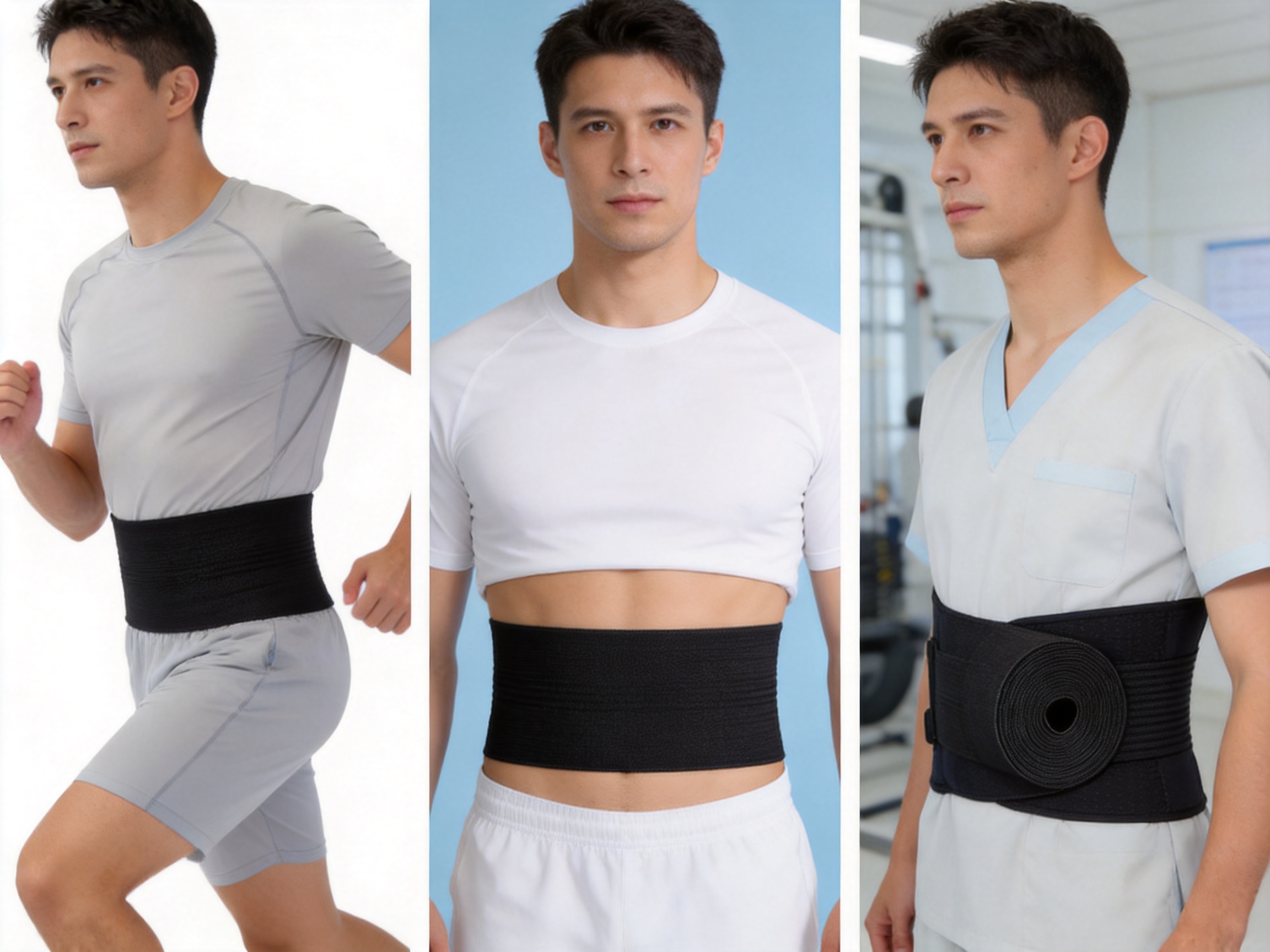
Abdominal Binders
Abdominal binders require broad, stable materials to support the midsection. The 8cm knitted elastic can be considered for binder panels, reinforcement sections, adjustable areas, or internal support structures, depending on the design.
Its width can help distribute contact pressure across the abdominal area. The flexible construction can also allow the binder to follow body movement more naturally than a rigid strip. Breathability and softness are valuable when the binder is worn for extended periods.
Medical and support-product manufacturers should establish their own testing standards for fit, comfort, recovery, fastening compatibility, and repeated use. If the finished product is intended for regulated medical applications, the manufacturer must also address all applicable regulatory, labeling, risk-management, and validation requirements.
Orthopedic Braces and Sports Supports
Sports supports and orthopedic braces often require elastic components that hold sections in place while allowing a controlled range of motion. Wide knitted elastic may be used in knee supports, elbow supports, back supports, shoulder products, limb braces, and related protective equipment.
The band can be combined with hook and loop fasteners, woven panels, padding, mesh, foam, laminated fabrics, or other webbing types. Its role may be to provide circumferential support, stabilize a panel, assist adjustment, or improve the fit of the finished brace.
The correct elasticity depends on the intended function. A product designed for light stabilization may require a different performance level from a product designed for strong compression. Customers should communicate application requirements clearly when requesting samples or customized production.
Medical Protective Equipment
Medical protective equipment often demands reliable materials, clean processing, consistent dimensions, and dependable supply. The product’s soft touch, wide coverage, and stable stretch make it relevant to selected medical and protective textile designs.
Hengxiang’s experience in elastic and non-elastic webbing for sports supports and orthopedic braces provides a foundation for serving medical textile customers. The company has obtained Oeko-Tex Standard 100 and ISO 13485 certificates, reflecting its attention to textile safety and medical quality-management requirements.
Certification does not replace application-specific validation. Customers should confirm whether the proposed material and finished product meet the requirements of their target market, intended use, and regulatory category.
Manufacturing Strengths and Production Capabilities
More Than Two Decades of Industry Experience
Jinhu Hengxiang Webbing Co., Ltd. was established in 2005 in Jinhu County, Huai’an City, Jiangsu Province, China. The company specializes in the research, development, production, sale, and service of elastic and non-elastic webbing.
Its product focus includes materials for sports supports, orthopedic braces, medical protective equipment, garments, and other textile applications. More than 20 years of professional experience gives the company practical knowledge of material selection, textile construction, production organization, quality control, and customer service.
Long-term experience is valuable because webbing performance depends on many interconnected variables. Yarn selection, machine settings, knitting structure, dyeing, inspection, packaging, and customer processing all influence the final result. An experienced manufacturer can better identify these relationships and support customers during development.
Integrated Equipment Investment
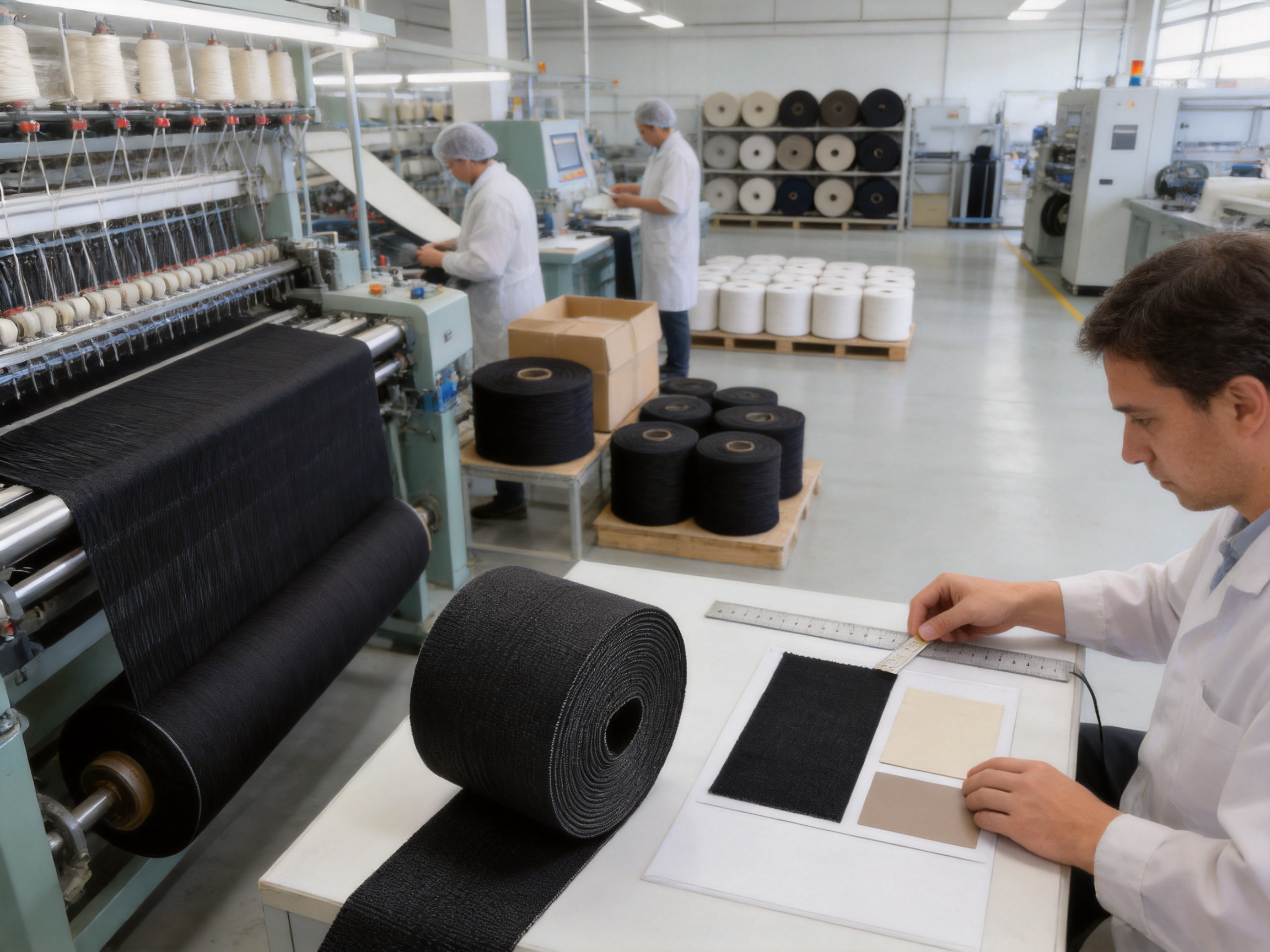
In recent years, Hengxiang has introduced and updated advanced production equipment, including warping machines, knitting machines, woven machines, and packaging machines. This equipment supports a more organized manufacturing process from preparation through finished-product handling.
Warping equipment helps prepare yarns in an orderly and controlled manner before textile formation. Knitting machines are central to the production of knitted elastic, creating the looped structure that provides flexibility and recovery. Woven machines support the company’s non-elastic and woven webbing product lines. Packaging machines help improve finished-product handling and delivery consistency.
Investment in multiple stages of production allows the company to coordinate different operations more effectively. It also supports the development of both elastic and non-elastic webbing, giving customers access to a broader product range from one specialized supplier.
Large Monthly Production Capacity
The company produces millions of meters of elastic and non-elastic webbing every month. This production scale can support regular supply programs, repeat orders, and larger industrial requirements.
Capacity is especially important for customers who need continuity between sampling, pilot production, and mass manufacturing. A supplier with organized production resources may be better positioned to maintain delivery schedules and support increasing order volumes.
Large capacity must be combined with process control. Consistent output requires attention to raw-material sourcing, machine maintenance, production parameters, inspection, batch organization, and packaging. Hengxiang emphasizes strict quality control throughout material sourcing, processing, testing, and packing.
Quality Control from Material to Packing
Quality assurance begins before the knitting process. Raw materials should be selected and checked according to the intended product requirements. Inconsistent yarn can lead to differences in texture, width, stretch, color, or recovery.
During processing, machine operation and production parameters influence the stability of the knitted structure. Regular inspection can help identify issues such as uneven width, surface defects, inconsistent loops, or irregular elasticity before the material reaches the next stage.
Testing and final inspection help confirm whether the finished elastic meets internal standards and customer expectations. Depending on the order, evaluation may include appearance, width, stretch behavior, recovery, color, surface feel, roll presentation, and packaging condition.
Careful packing is also important. Elastic webbing must be protected from contamination, moisture, unnecessary compression, and handling damage during storage and transportation. Correct labeling and organized packaging help customers identify batches and manage incoming materials.
Certified Management and Textile Safety
Hengxiang has obtained Oeko-Tex Standard 100 and ISO 13485 certificates. Oeko-Tex Standard 100 is associated with testing textile products for harmful substances, while ISO 13485 is a quality-management standard related to medical devices and relevant organizations.
These certifications demonstrate the company’s commitment to structured quality practices and product safety awareness. For buyers in medical, sports, and protective-equipment markets, documented management systems can support supplier evaluation and purchasing confidence.
Customers should always confirm the current validity, scope, and applicability of certifications for a specific project. The required documentation may differ according to product category, destination market, and intended use.
Customization and OEM/ODM Services
Different products require different elasticity, texture, width, color, and finishing characteristics. A standard elastic may be suitable for one garment but unsuitable for a medical support or high-movement sports product. For this reason, customization is an important part of professional webbing supply.
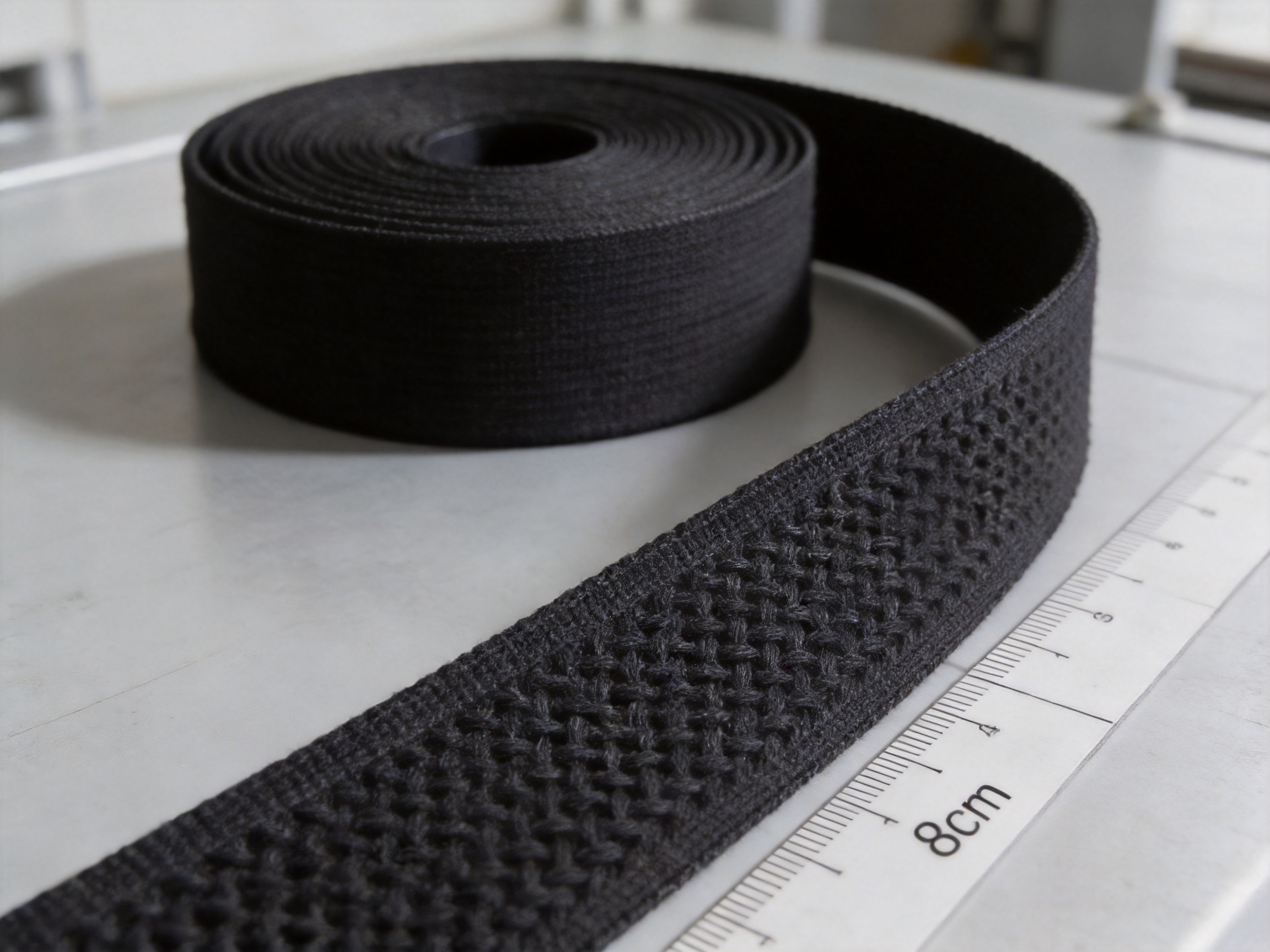
Hengxiang welcomes OEM and ODM orders. The company can provide customized webbing with tailored elasticity, texture, and color. These capabilities allow customers to develop materials that match their product structure and brand requirements more closely.
Customized Elasticity
Elasticity should be selected according to the intended use. A waistband may require comfortable recovery, while a support product may require stronger holding performance. The appropriate balance depends on the fabric, pattern, target user, wearing duration, and desired level of support.
When discussing a customized elastic, buyers should provide information such as the intended application, target width, approximate stretch requirement, recovery expectations, sewing method, and expected laundering conditions. Samples can then be evaluated in the actual product environment.
Customized Texture and Hand Feel
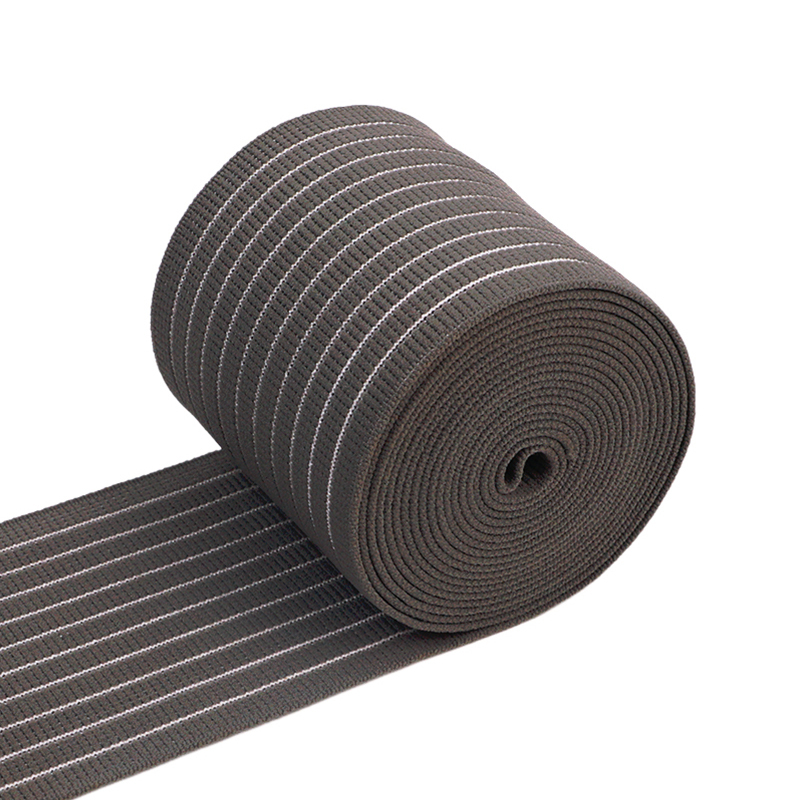
Texture influences both appearance and comfort. Some customers may prefer a smoother surface, while others may require a more breathable or structured knitted texture. The choice should reflect whether the elastic is exposed, enclosed, laminated, or placed next to the skin.
Sample development allows customers to compare touch, flexibility, thickness, surface appearance, and compatibility with other materials. This step is especially useful for underwear, shapewear, medical supports, and premium activewear.
Customized Color
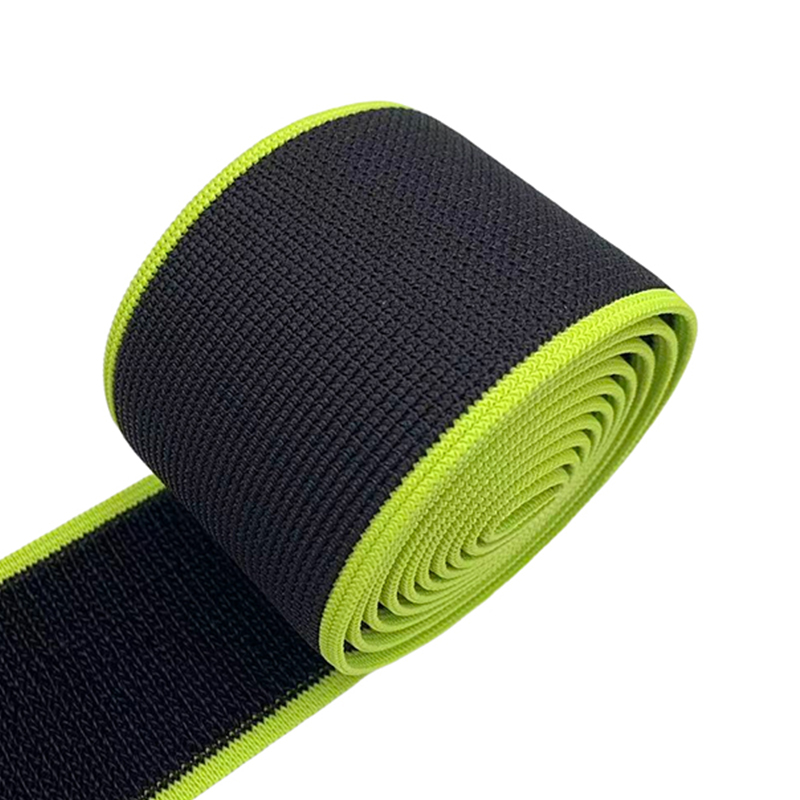
Although black is highly versatile, customized colors may be required for specific garment collections, corporate products, uniforms, or medical designs. Color development should consider the surrounding fabric, lighting, washing, and production batch consistency.
The 8cm Black Knitted Elastic is a strong standard option for customers who need a dependable, widely compatible color. For other projects, Hengxiang can discuss tailored color requirements as part of an OEM or ODM program.
How 8cm Black Knitted Elastic Compares with Other Elastic Types
| Elastic Type | Typical Strength | Potential Limitation | Suitable Use Considerations |
|---|---|---|---|
| 8cm knitted elastic | Wide coverage, soft touch, flexible structure, breathable feel, balanced stretch | Requires correct sewing and application testing | Waistbands, activewear, underwear, shapewear, abdominal binders, support products |
| Narrow elastic band | Compact size and easy use in small channels | May concentrate pressure and provide less coverage | Small garment sections, straps, narrow openings, lightweight applications |
| Woven elastic | Stable structure and firm surface | May feel less flexible or less breathable in certain designs | Belts, waistbands, straps, and applications requiring a firm woven appearance |
| Wide knitted elastic | Comfortable stretch and broad support area | Performance depends on yarn, loop structure, and finishing | Garments, body-support products, sports equipment, and medical textiles |
| Hook and loop strap | Adjustable fastening and easy opening | Usually needs a separate elastic or support component | Adjustable braces, binders, protective equipment, and closures |
| Medical elastic bandage | Designed for selected medical wrapping or support functions | Not necessarily intended for garment waistband construction | Medical and care-related applications according to product specifications |
The table illustrates that no single elastic type is ideal for every application. Narrow elastic can be efficient where space is limited, while woven elastic may be preferred when a firmer visual or structural surface is required. Hook and loop straps provide adjustment but do not always replace a wide elastic support panel.
The 8cm knitted elastic is most valuable when a design needs broad contact, comfort, flexibility, and repeated stretch recovery. Its competitive advantage lies in the combination of width, knitted construction, soft touch, breathable structure, and practical processing performance.
Design and Processing Recommendations
Confirm the Intended Function
Before ordering, determine whether the elastic is intended for comfort, retention, compression, support, adjustment, or a combination of these functions. The same 8cm width can be used in very different products, but the required performance may vary considerably.
A garment waistband may prioritize comfort and recovery. An abdominal binder may require greater stability. A sports support may need a secure fit during movement. Defining the function helps the supplier recommend an appropriate specification.
Test Stretch and Recovery in the Finished Product
Material testing on a flat sample is useful, but finished-product testing is essential. Sewing, fabric layering, seam direction, pattern shape, and tension can change the way the elastic performs.
Prototype testing should examine extension, recovery, comfort, edge behavior, stability, and appearance. Repeated-use testing can help identify whether the band remains effective after multiple stretch cycles and cleaning processes.
Use Appropriate Sewing Settings
Elastic should be sewn using settings that preserve its structure. Excessive presser-foot pressure, incorrect thread tension, unsuitable stitch density, or overstretching during assembly can cause puckering and distortion.
Manufacturers should make a small trial using the actual fabric and sewing equipment planned for production. The trial can confirm whether the elastic needs to be sewn flat, inserted into a casing, attached under controlled tension, or combined with another support layer.
Consider Seam Placement
Seam location affects comfort and durability. A seam positioned directly against the skin may be more noticeable than one placed in a less sensitive area or covered by a soft layer. In support products, the seam must also withstand repeated tension without creating a hard pressure point.
Designers should consider whether the elastic will be joined end-to-end, attached along one or both edges, enclosed inside a panel, or integrated with hook and loop components. Each structure may require different reinforcement and finishing methods.
Evaluate Care and Washing Conditions
The product is designed with durable and wash-resistant black color, but the complete garment or support product must still be tested under its intended care conditions. Water temperature, detergent, drying method, mechanical agitation, and chemical exposure can affect textile performance.
Customers should conduct laundering tests according to the final product’s care instructions. If the item is intended for frequent washing or institutional use, repeated-care testing is particularly important.
Why Choose a Specialized Webbing Manufacturer?
Specialized webbing manufacturers understand that elastic is not merely an accessory. It is a performance component that can influence fit, safety, comfort, appearance, and product durability.
A specialist can support material selection, prototype development, production scaling, quality control, packaging, and delivery planning. This is especially valuable for customers working with technical garments, medical supports, orthopedic braces, sports protection, and other products where performance requirements are more demanding than those of ordinary decorative trims.
Jinhu Hengxiang Webbing Co., Ltd. focuses on elastic and non-elastic webbing rather than treating webbing as a minor part of a larger textile portfolio. Its product knowledge is supported by dedicated warping, knitting, weaving, and packaging equipment, as well as established experience in sports and medical-related applications.
The company’s commitment to strict quality control covers material sourcing, processing, testing, and packing. This process-based approach can help reduce variation and provide customers with more dependable supply. Its large monthly production capacity also supports both regular orders and larger-scale manufacturing programs.
Hengxiang offers competitive pricing, timely delivery, reliable quality, and customized development. These strengths are important to buyers who need more than a catalog product and want a supplier capable of supporting long-term cooperation.
Quality, Sustainability, and Long-Term Value
Product value should be evaluated through the complete service life rather than the purchase price alone. Elastic that loses recovery quickly, curls during use, fades after washing, or causes discomfort may increase returns, rework, and replacement costs.
The 8cm Black Knitted Elastic is designed to provide a combination of stable elasticity, shape retention, comfort, and durable appearance. These qualities can support longer-lasting finished products when the material is correctly selected and processed.
Sustainability also includes efficient production, reduced waste, suitable product durability, and responsible supplier management. A material that performs well over repeated use may help reduce premature replacement. Accurate cutting, stable width, and consistent quality can also support more efficient manufacturing.
Hengxiang expresses a commitment to quality, innovation, and sustainability. The company aims to build lasting partnerships through integrity, responsibility, and continuous improvement. For customers, this approach can create value beyond a single shipment by supporting stable product development and long-term supply planning.
Purchasing Checklist for Buyers
When evaluating 8cm Black Knitted Elastic, buyers should first confirm the required width and whether the nominal 8cm format matches the finished design. They should also clarify the acceptable dimensional tolerance for their application.
The next consideration is stretch and recovery. Buyers should explain whether the band will be used for a waistband, support product, medical accessory, sports garment, or another purpose. The supplier can then discuss the most appropriate specification or customization route.
Surface feel and color should be reviewed through samples. This is especially important when the elastic will touch the skin or remain visible in the finished product. Customers should assess softness, breathability, black color consistency, and compatibility with adjacent fabrics.
Processing requirements should also be communicated. Useful information includes cutting method, sewing equipment, stitch type, seam construction, washing conditions, packaging format, roll length, and expected order volume.
For medical and protective applications, customers should request applicable technical and quality documentation. They should also determine whether additional testing or regulatory review is required for the finished product in the target market.
Finally, buyers should consider production capacity and delivery reliability. A supplier that can support sampling, repeat orders, customization, and larger production volumes may offer greater value than a supplier focused only on low initial pricing.
Frequently Asked Questions
What is the width of this elastic?
The product has a nominal width of 8cm. Its wide format is intended to provide broader coverage and more even tension distribution than narrow elastic bands.
What is the product model?
The product is identified as model 8050 and is sold as 8cm Black Knitted Elastic.
What makes knitted elastic different from woven elastic?
Knitted elastic is formed through an interlooping structure that generally provides a flexible, soft, and breathable textile feel. Woven elastic is formed through crossing yarn systems and may provide a firmer or more structured surface. The best choice depends on the intended application.
Is this elastic suitable for direct skin contact?
Its soft touch and breathable knitted structure make it suitable for applications where comfort is important, including selected garments, activewear, underwear, shapewear, and support products. Final skin comfort depends on the complete product design and should be confirmed through sample testing.
Can it be used for abdominal binders?
Yes. The 8cm width and flexible construction make it a potential component for abdominal binders and related support products. The final specification should be evaluated according to the required support level, fit, fastening system, and intended use.
Can it be used in sports supports and orthopedic braces?
Yes. It can be incorporated into selected sports supports, orthopedic braces, and protective products where broad elastic coverage and repeated recovery are required. Product-specific testing is recommended before mass production.
Is the black color durable?
The product features even dyeing and wash-resistant black color. Customers should still evaluate the completed product under its actual washing, drying, and usage conditions.
Can the elastic be customized?
Yes. Jinhu Hengxiang Webbing Co., Ltd. welcomes OEM and ODM orders and can customize elasticity, texture, and color according to customer requirements.
Is it easy to cut and sew?
The elastic is designed to be practical for cutting and sewing in both industrial production and DIY projects. Buyers should conduct a trial with their actual fabric, thread, machine, stitch, and tension settings.
What certificates does the manufacturer have?
The company has obtained Oeko-Tex Standard 100 and ISO 13485 certificates. Customers should confirm the current certificate validity and scope for their specific project.
What other products does the manufacturer supply?
The company supplies elastic and non-elastic webbing, including products associated with abdominal binders, woven wide elastic, wide knitted elastic, narrow elastic bands, woven elastic panels, elastic hook and loop straps, and medical elastic bandages.
Where is the manufacturer located?
Jinhu Hengxiang Webbing Co., Ltd. is located in Gongnong Village, Licheng Town, Jinhu County, Huai’an City, Jiangsu Province, China.
How can customers request product information?
Customers can contact the company to discuss specifications, samples, customization, OEM or ODM requirements, order volumes, packaging, and delivery schedules. The company’s listed contact email is john@mixshowint.com, and the listed telephone number is 0086-15895705812.
Conclusion
8cm Black Knitted Elastic is a versatile wide elastic material designed for comfort, stable stretch, broad tension distribution, and repeated use. Its knitted structure supports flexibility and breathability, while its soft touch makes it suitable for many garment, sports, underwear, shapewear, and support-product applications.
Compared with narrow elastic, the 8cm width can provide wider coverage and help reduce concentrated pressure. Compared with unstable or lower-quality alternatives, its strong recovery, shape retention, even black dyeing, and practical sewing performance can contribute to a more reliable finished product.
For customers seeking a professional supply partner, Jinhu Hengxiang Webbing Co., Ltd. combines more than 20 years of manufacturing experience with advanced warping, knitting, weaving, and packaging equipment. Its strict quality control, millions of meters of monthly production capacity, OEM and ODM services, Oeko-Tex Standard 100 certification, and ISO 13485 certification support its position as an experienced supplier of elastic and non-elastic webbing.
Whether the requirement is a standard black elastic for garment production or a customized component for sports protection and medical equipment, careful specification and sample testing remain essential. With the correct design, processing method, and quality-management support, 8cm Black Knitted Elastic can provide a dependable balance of comfort, functionality, appearance, and long-term value.
References
1. Product specification information for 8cm Black Knitted Elastic, model 8050.
2. Company information supplied by Jinhu Hengxiang Webbing Co., Ltd.
3. General textile engineering principles relating to knitted structures, elastic recovery, webbing construction, and garment assembly.
4. Oeko-Tex Standard 100 framework for textile product safety and harmful-substance evaluation.
5. ISO 13485 quality-management principles for organizations associated with medical devices.